How a BPO Company Could Build Client Trust Through Transparency
An illustrative look at how a BPO could strengthen client relationships with transparent time tracking, proof of work, and SLA-relevant reporting across its offshore teams.
Illustrative scenario. This is a composite example based on typical WorkComposer deployments — not a specific named customer. The company, figures, and quote are illustrative and show how the product is used, not guaranteed results.
Illustrative outcomes for a scenario like this
Scenario Profile
Picture a growing Business Process Outsourcing (BPO) company providing customer support, data entry, back-office processing, and virtual assistant services. With several hundred offshore employees across multiple delivery centers, it serves dozens of active clients across industries.
- Offshore Team
- ~500 people
- Footprint
- Multi-center
- Clients
- Dozens, multi-industry
- Key Need
- Client transparency
The Challenge
Client Trust Issues and Quality Verification Concerns
- Client Trust and Transparency Issues
Clients were skeptical about offshore team productivity and work quality. Without visibility into daily activities, clients questioned billable hours and suspected time inflation. This lack of transparency led to frequent disputes, client churn, and difficulty winning new business. Prospects cited "lack of oversight" as their primary concern.
- SLA Compliance and Performance Tracking
The company struggled to track and prove SLA compliance for metrics like response times, ticket resolution, and task completion. Without real-time visibility, SLA violations went undetected until clients complained. This reactive approach damaged client relationships and resulted in contract penalties and revenue loss.
- Quality Verification and Work Proof
The BPO had no systematic way to verify that work was actually being performed during billable hours. Quality assurance was manual and time-consuming. Clients demanded proof of work quality, but the company couldn't provide concrete evidence beyond output metrics. This made upselling additional services nearly impossible.
- Billing Transparency and Disputes
Monthly invoices lacked detailed breakdowns of how time was spent. Clients questioned billable hours, especially for tasks that seemed to take longer than expected. Billing disputes consumed significant management time and led to write-offs averaging 12% of monthly billings. Some clients withheld payment pending "investigation."
The Solution
Transparent Time Tracking with Client-Facing Dashboards
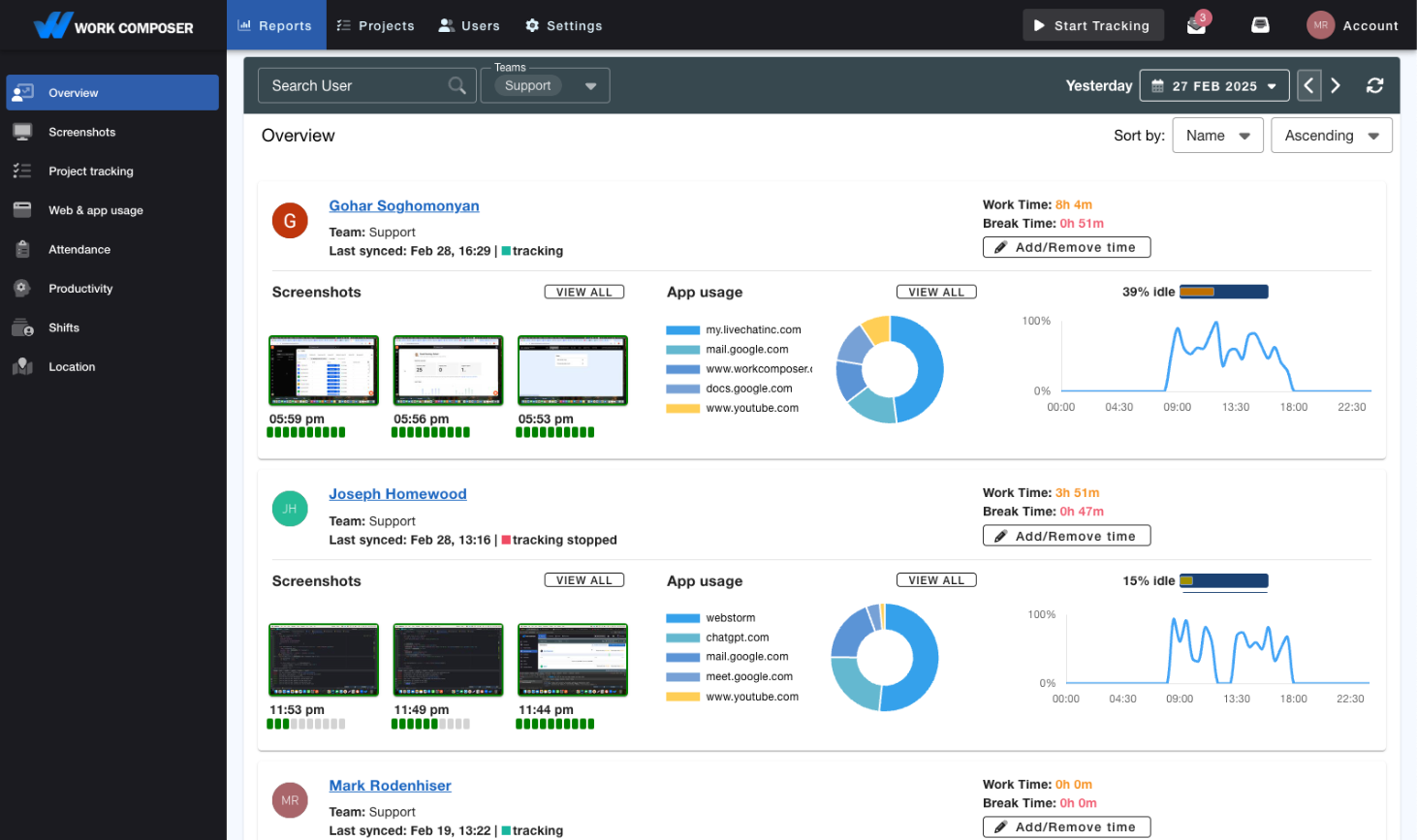
In this scenario, the BPO rolls out WorkComposer across its offshore teams with a focus on client transparency, SLA-relevant monitoring, and verifiable proof of work. Client-ready transparency reports give customers a clear view of team productivity and task completion.
- 1. Transparent Time Tracking with Activity Proof
- All offshore team members used automatic time tracking with optional screenshots and activity logs. This provided verifiable proof that work was being performed during billable hours. Clients could see exactly what their teams were working on, eliminating trust issues and billing disputes.
- 2. Real-Time SLA Compliance Monitoring
- The system tracked SLA metrics in real-time—response times, ticket resolution, task completion rates. Managers received instant alerts when teams approached SLA thresholds, enabling proactive intervention before violations occurred. This transformed SLA management from reactive to preventive.
- 3. Client-Ready Transparency Reports
- The BPO shared client-ready reports showing each dedicated team's productivity, task completion, time allocation by project, and optional screenshots and activity summaries. Clients could review exactly what their team accomplished, providing clear transparency into offshore operations.
- 4. Detailed Billing Reports with Work Verification
- Monthly invoices included comprehensive time breakdowns showing exactly how hours were spent, which tasks were completed, and optional work samples. This transparency eliminated billing disputes and positioned the BPO as a premium provider rather than competing solely on price.
Implementation
Phased Rollout Across Three Delivery Centers
Started with 50 employees serving the company's top 5 clients. Configured client dashboards, set up SLA monitoring rules, and established privacy settings for screenshots. Collected feedback from both clients and team members to refine the implementation approach.
Deployed to 250 employees at the Manila delivery center. Conducted training sessions in English and Tagalog. Set up department-specific tracking rules for customer support, data entry, and virtual assistant teams. Integrated with existing ticketing and project management systems.
Extended to 200 employees across two India locations (Bangalore and Hyderabad). Created client-specific dashboards for all 75 active clients. Configured SLA monitoring rules tailored to each client's service level agreements.
The BPO begins sharing client-ready transparency reports so customers can see their team's productivity and work quality. In a scenario like this, the transparency is typically what shifts client conversations from skepticism to trust.
Potential Results
The Kind of Impact a BPO Could See
The outcomes below are illustrative of what teams in this situation tend to aim for — not measured results from a specific customer.
- ↑Higher Client Satisfaction
- When clients can see what their dedicated team accomplished, the trust concerns that dog offshore outsourcing tend to fade — and satisfaction scores rise with the added visibility.
- ✓Better SLA Monitoring
- Tracking work hours and activity in near real time lets managers spot SLA risks earlier and intervene proactively, instead of finding out about a missed commitment when a client complains.
- ↑Stronger Growth Position
- Transparency can become a competitive advantage — existing clients expand their teams, and prospects who were wary of offshore work are reassured by verifiable proof of work.
- ↓Fewer Billing Disputes
- Detailed billing reports backed by activity logs and optional work samples give clients confidence in invoices, which tends to cut write-offs and shorten payment collection time.
- ★Better Retention
- Clients who can see the value they receive are more likely to renew and expand — transparency gives account teams something concrete to point to during renewal conversations.
- $Pricing Power
- Verifiable quality and visibility can support positioning as a premium provider rather than competing on price alone, especially with clients that require stringent oversight.
Why BPOs take this approach
The shift is from competing on price and constantly defending offshore teams, to competing on quality and trust — clients see the value delivered, which strengthens retention and supports premium pricing.
This scenario is illustrative. The fastest way to see how the transparency reporting lands with your own clients is a free trial, or read more on our BPO solutions page.
Related Solutions
Explore How WorkComposer Can Help Your Business
BPO & Outsourcing Time Tracking
Build client trust with transparent time tracking and ensure SLA compliance across offshore teams.
Remote Team Time Tracking
Track distributed teams without micromanaging and build accountability across time zones.
Employee Accountability
Build team accountability with transparent time tracking and fair performance measurement.
Ready to transform your team's productivity?
Join 200,000+ users tracking time smarter. Start your free trial today—no credit card required.
- Setup takes less than 5 minutes
- Full access to all features
- Cancel anytime, no questions asked
- Dedicated support to get you started