BPO: Building Client Trust Through Transparency
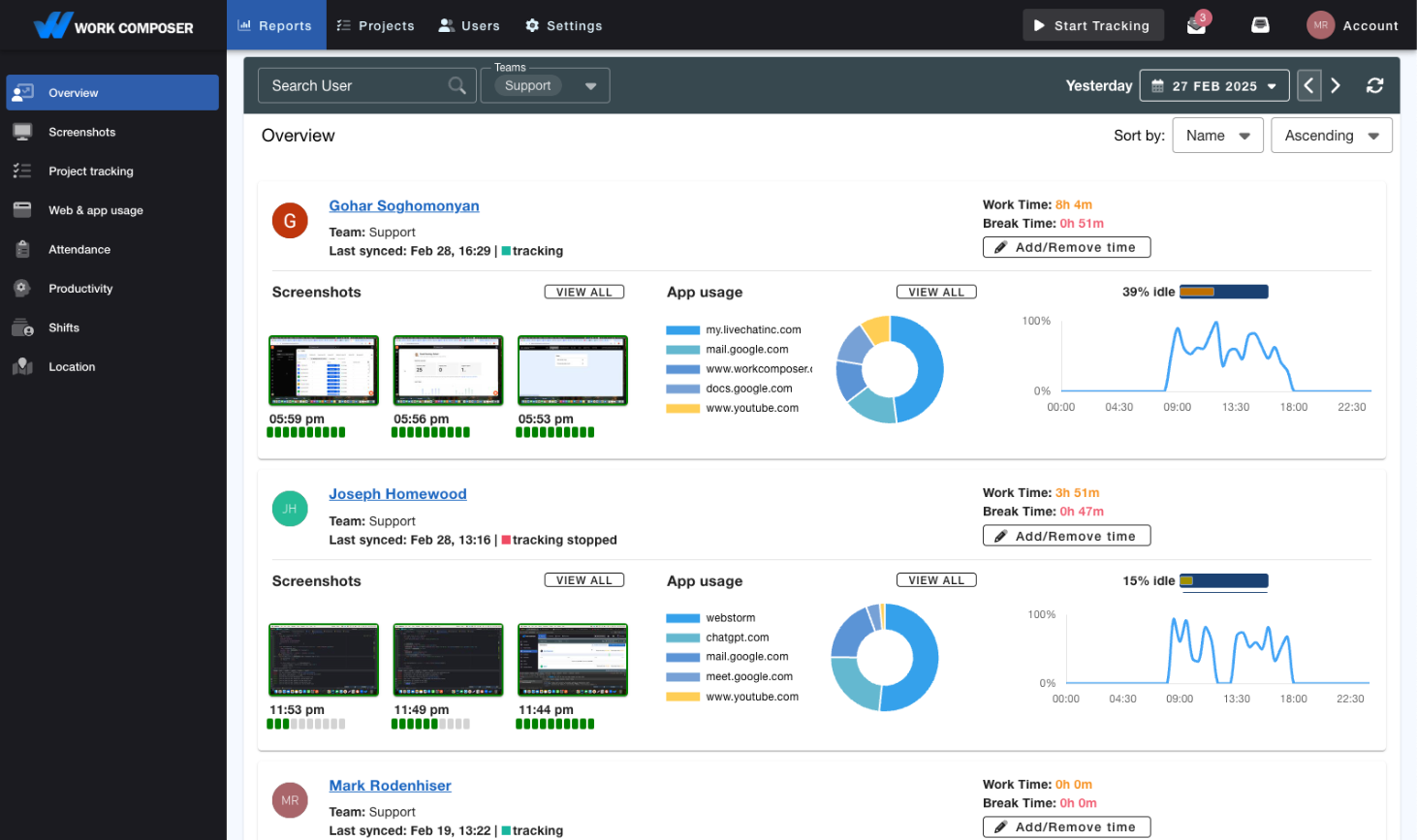
An illustrative scenario showing how a BPO could use transparent time tracking and proof of work to address client skepticism about offshore teams and monitor SLA-relevant metrics in real time.
Illustrative examples of how teams across industries can put WorkComposer to work. Each scenario walks through a typical situation, setup, and the kind of outcome teams in that position tend to look for.
Illustrative scenarios. The examples below are composite scenarios based on typical WorkComposer deployments — not write-ups of specific named customers. Figures are illustrative and meant to show how the product is used, not guaranteed results.
An illustrative scenario showing how a BPO could use transparent time tracking and proof of work to address client skepticism about offshore teams and monitor SLA-relevant metrics in real time.
An illustrative scenario showing how a regulated employer could build verifiable, audit-ready labor records — work hours, breaks, and overtime — to support DOL and FLSA documentation requirements.
An illustrative scenario showing how a creative agency could use automatic time tracking and proof of work to capture billable hours that manual timesheets tend to miss and reduce client billing disputes.
An illustrative scenario showing how an agency working with freelance contractors could verify hours with proof of work, monitor project budgets in real time, and protect project profitability.
An illustrative scenario showing how a large organization could consolidate fragmented departmental time systems onto one platform with department-specific workflows and unified reporting.
An illustrative scenario showing how a healthcare provider could track administrative staff productivity using privacy-first controls — screenshots disabled or blurred for PHI roles — that support a HIPAA-compliant workflow.
An illustrative scenario showing how a hybrid company could use the same objective time data for office and remote workers to reduce proximity bias and make performance reviews more consistent.
An illustrative scenario showing how a law firm could improve billable realization by capturing time that manual entry tends to lose, reduce billing disputes with proof of work, and keep audit-ready records.
An illustrative scenario showing how a manufacturing company with hourly shift workers could replace paper timesheets with automatic time capture, cut payroll processing time, and keep audit-ready records.
An illustrative scenario showing how a professional services firm could capture billable time that goes unlogged, improve billing realization, and reduce write-offs with automatic billable-hour capture.
An illustrative scenario showing how a distributed startup could build accountability through transparency rather than surveillance, coordinate across time zones, and back operational decisions with real data.
An illustrative scenario showing how a small consulting firm could move off spreadsheets to automatic time capture, deliver detailed client billing reports, and see which engagements are profitable.
An illustrative scenario showing how an engineering team could use development-focused time data to calibrate sprint estimates, surface bottlenecks like slow code review, and plan capacity with real numbers.
Learn how productivity improvement without micromanagement achieved success with WorkComposer time tracking and productivity monitoring.
Learn how project profitability optimization achieved success with WorkComposer time tracking and productivity monitoring.
Join 200,000+ users tracking time smarter. Start your free trial today—no credit card required.
