How a Distributed Agency Could Verify Freelancer Hours and Cut Time Theft
An illustrative look at how an agency working with a network of freelance contractors could verify hours with proof of work, curb inflated time claims, and protect project profitability.
Illustrative scenario. This is a composite example based on typical WorkComposer deployments — not a specific named customer. The company, figures, and quote are illustrative and show how the product is used, not guaranteed results.
Illustrative outcomes for a scenario like this
Scenario Profile
Picture a distributed digital marketing agency serving mid-market clients with a hybrid workforce: a small core of full-time employees plus a network of specialized freelance contractors (designers, developers, copywriters, social media specialists). The agency juggles dozens of active client projects with team members spread across many countries.
- Core Team
- ~20 people
- Freelance Network
- ~50 contractors
- Footprint
- Fully distributed
- Key Need
- Verify contractor hours
The Challenge
Freelancer Time Inflation and Project Profitability Uncertainty
- Freelancer Time Inflation
Freelance contractors submitted self-reported hours with no verification. The agency suspected significant time inflation—tasks that should take 5 hours were billed at 8-10 hours. Without proof of work, the agency had no way to challenge inflated claims, leading to budget overruns and unprofitable projects.
- Project Profitability Uncertainty
Fixed-price projects regularly exceeded budget due to unverified contractor hours. The agency had no real-time visibility into how much freelancer time was being consumed. By the time invoices arrived, projects were already over budget with no recourse to recover costs or adjust scope.
- Quality and Productivity Concerns
The agency couldn't verify whether freelancers were actually working during billed hours or what quality of work was being produced. Some contractors delivered subpar work that required expensive revisions, yet still charged full rates. The lack of accountability damaged client relationships and profit margins.
- Client Billing Pass-Through Issues
When passing freelancer costs through to clients, the agency couldn't provide proof of hours worked. Clients questioned freelancer charges, leading to billing disputes and write-offs. The agency absorbed these costs rather than damage client relationships, directly impacting profitability.
The Solution
Freelancer Time Tracking with Mandatory Proof of Work
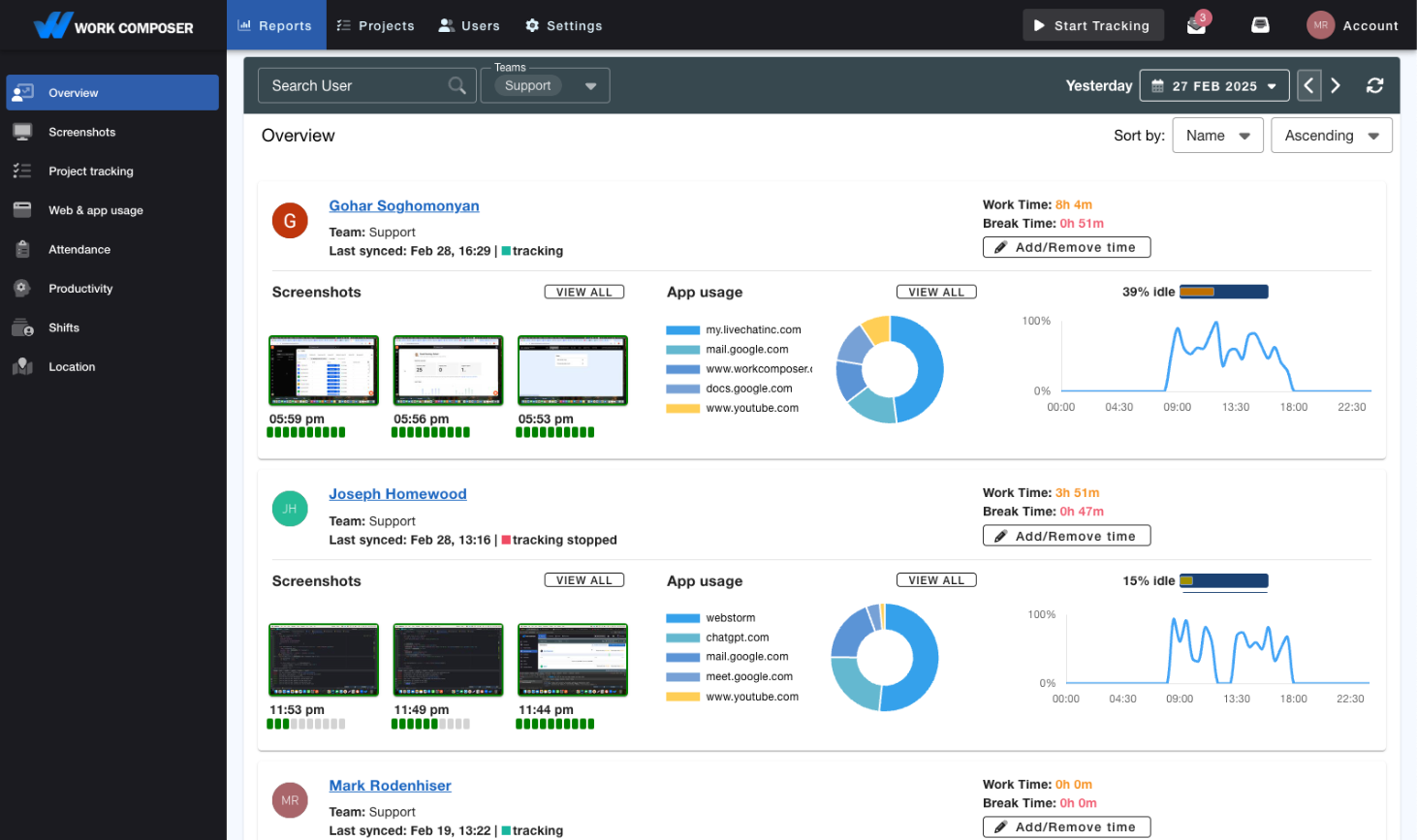
In this scenario, the agency rolls out WorkComposer to its freelance contractors with mandatory time tracking and proof-of-work verification. That gives real-time visibility into contractor activity, verified hours worked, and the data needed to catch inflated time claims and protect project profitability.
- 1. Mandatory Freelancer Time Tracking
- All freelance contractors were required to use WorkComposer time tracking as a condition of engagement. Automatic time tracking captured exactly when contractors were working on agency projects, eliminating self-reported hours and providing verifiable data for billing and project budget tracking.
- 2. Proof of Work Verification
- Screenshots and activity logs provided concrete proof of work performed. Project managers could verify that contractors were actually working during billed hours and review work quality before approving payment. This eliminated inflated time claims and provided accountability for deliverable quality.
- 3. Real-Time Project Budget Monitoring
- Dashboards showed real-time freelancer time consumption against project budgets. Project managers received alerts when projects approached budget limits, enabling proactive scope adjustments or contractor reallocation before projects became unprofitable. Budget overruns became preventable rather than inevitable.
- 4. Client-Ready Billing Documentation
- For pass-through billing to clients, the agency could now provide detailed reports showing exactly what contractors did, when they worked, and optional work samples. This transparency eliminated client disputes over freelancer charges and positioned the agency as a trustworthy partner rather than a cost center.
Implementation
Phased Rollout Across Freelance Network
Started with 10 most-used freelance contractors. Explained the business case for time verification, provided training on WorkComposer, and addressed privacy concerns. Most contractors welcomed the transparency as it protected their reputation and eliminated disputes over hours worked.
Extended to all 50 contractors with a clear policy: time tracking required for all new projects. A few contractors objected and left the network—these were precisely the contractors with suspected time inflation issues. The remaining contractors adapted quickly and appreciated the professionalism.
Trained internal project managers on reviewing contractor time data, identifying anomalies, and using budget monitoring dashboards. Established approval workflows requiring PM review before contractor payment processing.
In a scenario like this, verified data often shows some contractors logging materially fewer hours than they had self-reported — surfacing inflated charges early. The agency can then concentrate work with verified high-performers from the network.
Potential Results
The Kind of Impact an Agency Could See
The outcomes below are illustrative of what teams in this situation tend to aim for — not measured results from a specific customer.
- $Less Inflated Billing
- Proof-of-work verification curbs time inflation across a freelancer network — recovering costs that would otherwise leak away, often the equivalent of meaningful headcount without adding payroll.
- ↑Healthier Project Margins
- Fixed-price projects that used to run over budget can become profitable when contractor time is verified and real-time budget monitoring catches overruns before they bite.
- ✓Verified Contractor Hours
- Every freelancer hour backed by proof of work lets project managers approve contractor payments with confidence — and removes a common source of dispute with both contractors and clients.
- ↓Fewer Budget Overruns
- Real-time budget monitoring turns overruns from an after-the-fact surprise into something PMs can manage — adjusting scope or reallocating resources before profitability is compromised.
- ↑Better Output Quality
- Accountability through proof of work tends to lift output quality — contractors who know their work will be reviewed deliver better results, which can reduce client revision cycles.
- ★Stronger Freelancer Network
- Transparent accountability tends to retain high-quality contractors and filter out poor performers, leaving a network that's more reliable and professional over time.
Why distributed agencies take this approach
When you can't see what freelancers actually worked, inflated hours quietly erode margins. The appeal is verification and proof of work — which protects margins and, for honest contractors, protects their reputation too.
This scenario is illustrative. If your agency runs on a freelance network, the best way to see the numbers is to start a free trial.
Related Solutions
Explore How WorkComposer Can Help Your Business
Freelancer & Contractor Management
Verify freelancer work hours with proof of work and ensure accurate invoicing.
Agency Time Tracking
Maximize profitability with project insights and transparent client billing.
Ready to transform your team's productivity?
Join 200,000+ users tracking time smarter. Start your free trial today—no credit card required.
- Setup takes less than 5 minutes
- Full access to all features
- Cancel anytime, no questions asked
- Dedicated support to get you started