How a Large Organization Could Centralize Time Tracking Across Thousands of Employees
An illustrative look at how a multi-national organization could consolidate fragmented departmental time systems onto one platform, standardize reporting, and support compliance across locations.
Illustrative scenario. This is a composite example based on typical WorkComposer deployments — not a specific named customer. The company, figures, and quote are illustrative and show how the product is used, not guaranteed results.
Illustrative outcomes for a scenario like this
Scenario Profile
Picture a large multi-national organization providing professional services across several regions. With a few thousand employees spanning many departments and regional offices, it operates in a complex, multi-jurisdictional environment with varying labor regulations, client billing requirements, and internal governance policies.
- Scale
- 2,000+ people
- Structure
- Many departments
- Footprint
- Multi-region
- Key Need
- Standardization
The Challenge
Decentralized Time Tracking Creating Compliance and Reporting Chaos
- Decentralized Systems and Inconsistent Data
Each department used different time tracking systems—some used spreadsheets, others used legacy software, and a few had no formal system at all. This created data silos with inconsistent formats, making enterprise-wide reporting impossible. Leadership had no unified view of workforce utilization, project costs, or labor compliance.
- Compliance Gaps and Audit Risk
Different departments followed different compliance standards based on their legacy systems. Some locations couldn't prove overtime compliance, others lacked adequate break tracking, and several departments had no audit trail for billable hours. This created substantial legal and financial exposure during regulatory audits.
- Inconsistent Reporting and Analytics
Executive leadership couldn't get consistent reports across departments. Each region provided data in different formats with different metrics, making strategic decision-making impossible. Consolidating reports for board meetings required weeks of manual data reconciliation by finance teams.
- Department-Specific Workflow Requirements
Different departments had unique requirements—consulting needed client billing, HR needed overtime tracking, operations needed shift management, and IT needed project allocation. Previous attempts at centralization failed because one-size-fits-all solutions didn't accommodate department-specific needs.
The Solution
Enterprise-Wide Time Tracking with Department-Specific Workflows
In this scenario, the organization rolls out WorkComposer across all employees on a centralized platform that accommodates department-specific workflows, compliance requirements, and reporting needs — while giving leadership unified, standardized visibility.
- 1. Centralized Platform with Department Customization
- WorkComposer provided a single enterprise platform with customizable workflows for each department. Consulting teams tracked billable client hours, operations tracked shifts and overtime, HR tracked compliance metrics, and IT tracked project allocation—all within one unified system with consistent data standards.
- 2. Compliance-First Configuration for Multi-Jurisdictional Operations
- The system was configured with location-specific compliance rules reflecting labor laws across 8 regional offices. Automatic overtime calculations, break tracking, and audit trails were tailored to each jurisdiction's requirements, ensuring compliance across all locations while maintaining centralized oversight.
- 3. Unified Reporting and Executive Dashboards
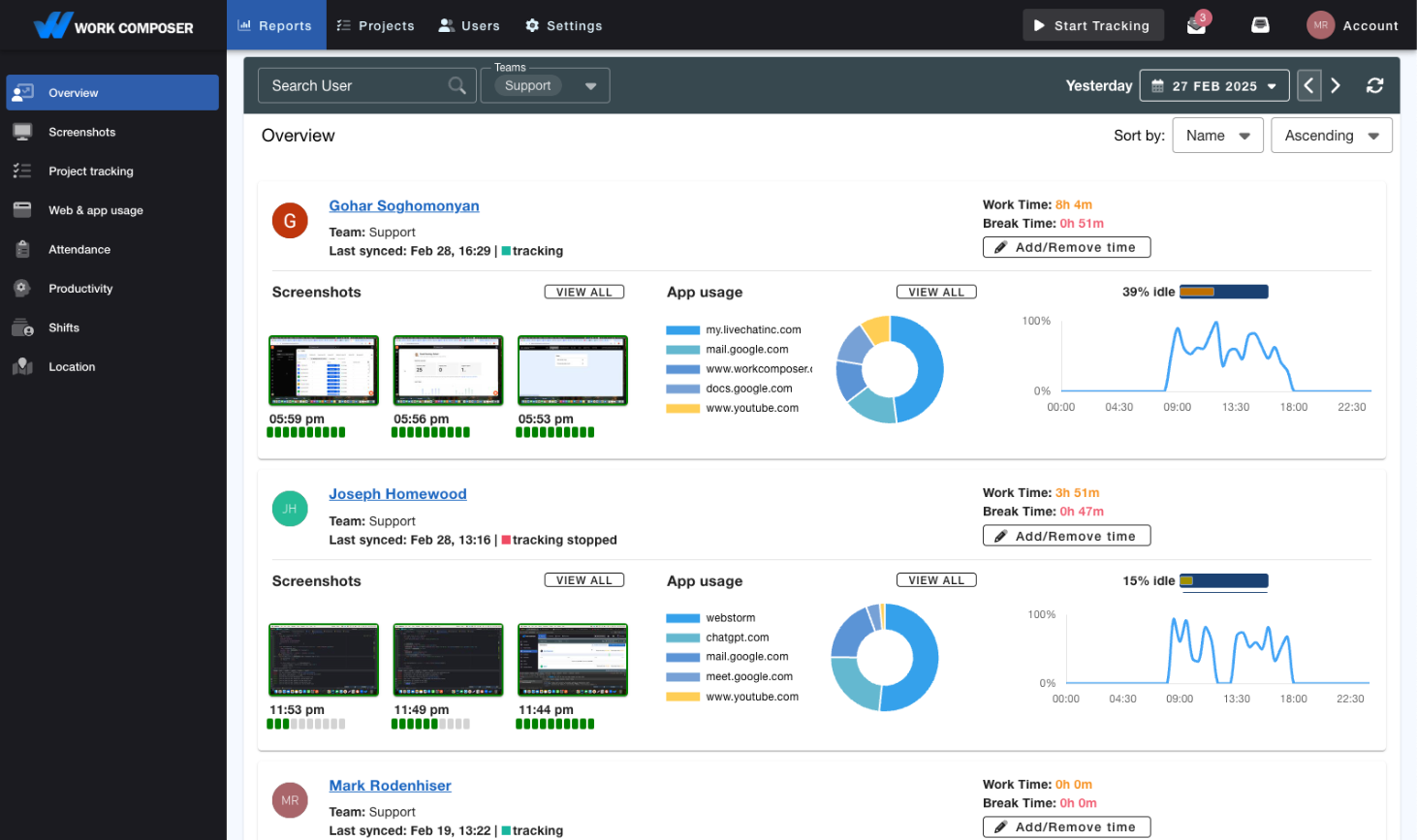
- For the first time, executive leadership gained real-time visibility into workforce utilization, labor costs, project profitability, and compliance status across all departments and locations. Standardized data enabled consistent reporting, strategic analysis, and data-driven decision-making at the enterprise level.
- 4. Phased Implementation with Change Management
- Rather than forcing immediate adoption, the implementation was phased by department with dedicated change management support. Each department received customized training, workflow optimization, and stakeholder buy-in before rollout. This ensured successful adoption across the diverse enterprise organization.
Implementation
Strategic Phased Rollout Across Enterprise Organization
Secured executive sponsorship and formed cross-functional implementation team. Selected consulting department (250 employees) as pilot due to complex billable hour requirements. Configured department-specific workflows, compliance rules, and reporting structures. Pilot proved concept and identified best practices.
Deployed to 5 departments across 4 North American offices (800 employees). Configured location-specific compliance rules for US and Canadian labor laws. Established regional support teams and department champions. Conducted extensive training programs tailored to each department's workflows.
Extended to European operations (4 offices, 600 employees) with EU-specific compliance configurations including GDPR data protection, works council requirements, and jurisdiction-specific labor laws. Integrated with local payroll providers and established multilingual support.
Deployed to remaining specialized departments including IT, finance, and corporate functions (400 employees). Achieved 100% enterprise coverage across all 2,000+ employees. Optimized workflows based on 9 months of usage data. Established enterprise-wide reporting standards and executive dashboards.
Heading into the first enterprise-wide compliance review, the goal is centralized documentation, consistent data standards, and comprehensive audit trails covering all departments and jurisdictions — the records an audit at this scale demands.
Potential Results
The Kind of Impact a Large Organization Could See
The outcomes below are illustrative of what organizations in this situation tend to aim for — not measured results from a specific customer.
- $Lower Total Cost
- Consolidating onto one platform can cut administrative overhead from decentralized systems, recover previously unbilled hours, and reduce audit-preparation costs — savings that compound at enterprise scale.
- ✓Consistent Compliance Records
- One set of comprehensive audit trails across all departments and locations helps satisfy multi-jurisdictional labor requirements and closes the compliance gaps that fragmented systems tend to leave.
- ↓Faster Reporting
- Executive reporting that once took weeks of manual data reconciliation can be generated in minutes once data is standardized — feeding real-time dashboards on utilization, labor cost, and project profitability.
- 📊Unified Visibility
- Leadership gains a single, consistent view of workforce operations across departments and locations, so strategic decisions and board reporting rest on verifiable metrics rather than guesswork.
- ↑Better Workforce Utilization
- Centralized visibility surfaces underutilized capacity in some teams and overwork in others, supporting resource reallocation that improves utilization without adding headcount.
- ↓Fewer Systems to Maintain
- Retiring a patchwork of departmental time-tracking tools in favor of one platform reduces licensing spend, IT support burden, and integration complexity.
Why large organizations take this approach
The draw is replacing a patchwork of departmental systems with one platform that respects each team's workflow while giving leadership consistent, verifiable data across the whole organization.
This scenario is illustrative. Enterprises evaluating a consolidation like this usually start with a trial in one department before rolling out more broadly.
Related Solutions
Explore How WorkComposer Can Help Your Enterprise
Compliance & Audit Time Tracking
Maintain audit-ready records and ensure regulatory compliance across all locations.
Payroll Processing
Automate accurate payroll with precise time tracking across multiple departments.
Employee Accountability
Build accountability with transparent time tracking and fair performance measurement.
Ready to transform your team's productivity?
Join 200,000+ users tracking time smarter. Start your free trial today—no credit card required.
- Setup takes less than 5 minutes
- Full access to all features
- Cancel anytime, no questions asked
- Dedicated support to get you started