How a Fully Remote Startup Could Build Accountability Without Micromanagement
An illustrative look at how a distributed startup could build accountability through transparency rather than surveillance, coordinate work across time zones, and back operational decisions with real data.
Illustrative scenario. This is a composite example based on typical WorkComposer deployments — not a specific named customer. The company, figures, and quote are illustrative and show how the product is used, not guaranteed results.
Illustrative outcomes for a scenario like this
Scenario Profile
Picture a fast-growing SaaS startup with a remote-first philosophy, with around 35 team members spread across a dozen countries and many time zones. The team — engineers, designers, marketers, and customer success specialists — works asynchronously across continents.
- Team Size
- ~35 people
- Footprint
- ~12 countries
- Work Style
- Async, multi-timezone
- Key Need
- Trust + visibility
The Challenge
Building Accountability Without Surveillance Culture
- Accountability Without Micromanagement
As a remote-first startup, the founders wanted to build accountability without creating a surveillance culture. They needed visibility into team productivity and project progress, but traditional monitoring tools felt invasive and damaged trust. Finding the balance between accountability and autonomy was critical for their culture.
- Timezone Coordination Chaos
With team members across 9 time zones, coordinating work was challenging. The founders had no visibility into who was working when, leading to missed handoffs, delayed responses, and frustration. Async collaboration required better awareness of team availability and work patterns across time zones.
- Investor Skepticism About Remote Operations
During Series A fundraising conversations, investors expressed concerns about managing a fully distributed team. They questioned productivity metrics, operational efficiency, and whether remote teams could scale. The startup needed concrete data to demonstrate that their remote model was not only viable but superior.
- Project Delivery Uncertainty
Without visibility into actual work patterns, the leadership team couldn't accurately predict project delivery timelines. They had no data on how long different tasks actually took, making sprint planning guesswork and client commitments risky. This uncertainty made scaling operations difficult.
The Solution
Trust-Based Time Tracking with Async Collaboration Support
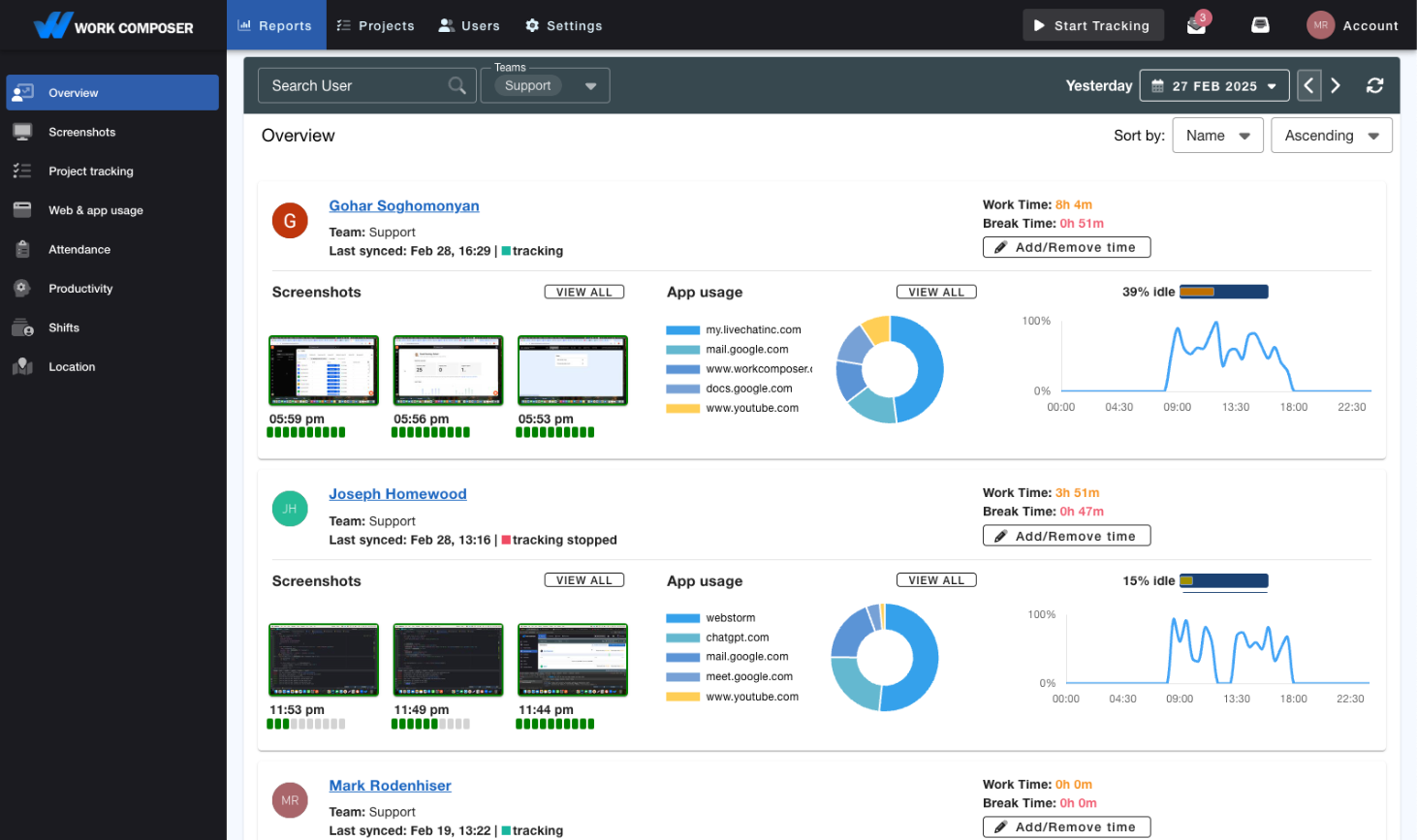
The startup implemented WorkComposer with a focus on transparency over surveillance, async collaboration support, and data-driven productivity insights that respected employee autonomy while providing the visibility needed for accountability and investor confidence.
- 1. Transparent, Employee-Controlled Tracking
- Rather than implementing invasive monitoring, the startup deployed WorkComposer with full transparency. Employees could see their own data, control screenshot frequency, and understand exactly what was being tracked. The emphasis was on self-accountability rather than top-down surveillance, building trust from day one.
- 2. Timezone-Aware Team Visibility
- The system displayed team availability across time zones in real-time. Everyone could see when colleagues were online, working, or offline—enabling better async coordination. Handoffs between timezone "shifts" became seamless, with visibility into work completed and tasks ready for the next person.
- 3. Productivity Metrics for Investor Confidence
- Leadership gains aggregate productivity metrics — team velocity, project completion rates, operational efficiency. In investor conversations, having concrete operational data about a distributed team is the kind of evidence that can turn skepticism about remote work into a point of confidence.
- 4. Async-First Work Pattern Insights
- Time tracking revealed actual work patterns across time zones, showing deep work hours, meeting overlap windows, and optimal handoff times. The company used this data to optimize async workflows, reduce unnecessary meetings, and structure sprints around natural collaboration windows spanning multiple time zones.
Implementation
Trust-First Rollout Across 12 Countries
Before deployment, leadership held company-wide meetings explaining exactly why time tracking was being implemented, what would be tracked, how data would be used, and emphasizing employee control over their data. Created a detailed FAQ addressing privacy concerns and cultural fit with remote-first values.
Founders and department heads used WorkComposer first to demonstrate trust and lead by example. They shared their own tracking data with the team, showing transparency from the top. Collected feedback on privacy settings, screenshot frequency, and timezone coordination features.
Deployed to all 35 employees across 12 countries with region-specific onboarding sessions accommodating different time zones. Each employee could customize privacy settings, screenshot frequency, and activity tracking preferences. Emphasized voluntary participation and self-accountability culture.
Within a couple of months, the team has concrete data on work patterns, timezone handoffs improve with that visibility, and a transparency-first rollout tends to land well in employee satisfaction surveys — the opposite of how surveillance-style monitoring usually lands.
Potential Results
The Kind of Impact a Remote Startup Could See
The outcomes below are illustrative of what teams in this situation tend to aim for — not measured results from a specific customer.
- ↑Higher Employee Satisfaction
- A trust-first rollout — where people control their own data and there's no micromanagement — tends to land far better than surveillance-style monitoring, and can even become a recruiting point.
- ↑Better Productivity Signal
- Better timezone coordination, fewer unnecessary meetings, and insight into deep-work hours can lift effective productivity — and give leadership a real read on it rather than a guess.
- 📊Evidence for Stakeholders
- Concrete operational metrics — velocity, completion rates, efficiency — give a distributed team something solid to show investors and boards who are skeptical that remote operations can scale.
- ↓Fewer Unnecessary Meetings
- Seeing how much time synchronous meetings consume helps a team find optimal overlap windows and shift to async handoffs — freeing hours for deep work.
- ↑Smoother Delivery
- Visibility into work patterns and timezone handoffs can turn a round-the-clock team into an advantage, with work progressing across zones rather than stalling between them.
- ★Stronger Retention
- A culture of trust and transparent accountability tends to support retention in a tight talent market — and can become part of how the company describes itself to candidates.
Why remote startups take this approach
The appeal is getting the accountability data a growing team needs without slipping into surveillance — respecting autonomy while having real operational evidence to show stakeholders who doubt that distributed teams can scale.
This scenario is illustrative. The best way to see whether a transparency-first rollout fits your culture is to try it with your own team.
Related Solutions
Explore How WorkComposer Can Help Your Remote Team
Remote Team Time Tracking
Build trust and accountability across distributed teams without micromanagement.
Employee Accountability
Transparent accountability tools that respect autonomy and build trust.
Software Development
Optimize engineering productivity and sprint velocity with data-driven insights.
Ready to transform your team's productivity?
Join 200,000+ users tracking time smarter. Start your free trial today—no credit card required.
- Setup takes less than 5 minutes
- Full access to all features
- Cancel anytime, no questions asked
- Dedicated support to get you started