How a Software Company Could Boost Productivity Without Micromanagement
An illustrative look at how a software company could move away from invasive monitoring toward a culture of trust — improving productivity, reducing burnout, and supporting retention.
Illustrative scenario. This is a composite example based on typical WorkComposer deployments — not a specific named customer. The company, figures, and quote are illustrative and show how the product is used, not guaranteed results.
Illustrative outcomes for a scenario like this
Scenario Profile
Picture a mid-size B2B SaaS company building project management tools, with around 65 employees — engineers, designers, product managers, and customer success — working in a hybrid setup across multiple time zones.
- Team Size
- ~65 people
- Work Model
- Hybrid
- Starting Point
- Invasive monitoring
- Key Need
- Trust + visibility
The Challenge
Micromanagement Culture Hurting Productivity and Morale
- Invasive Monitoring Practices
Management implemented aggressive monitoring tools that tracked every keystroke, took random screenshots, and sent alerts when activity dropped. Engineers reported feeling constantly watched and distrusted, leading to anxiety and reduced job satisfaction.
- High Employee Turnover
Employee turnover reached 35% annually, well above industry average. Exit interviews consistently cited "lack of trust" and "surveillance culture" as primary reasons for leaving. Recruiting and training costs were spiraling out of control.
- Productivity Theater Over Real Work
Team members focused on appearing busy rather than doing meaningful work. Engineers kept unnecessary windows open, moved their mouse to fake activity, and avoided necessary breaks. Deep focus work suffered as people prioritized "looking productive" over actual productivity.
- Burnout and Reduced Innovation
The pressure of constant surveillance led to burnout, stress-related health issues, and reduced creative problem-solving. Team members stopped taking initiative, avoided experimentation, and delivered only what was explicitly required—nothing more.
The Solution
Trust-Based Transparency with WorkComposer
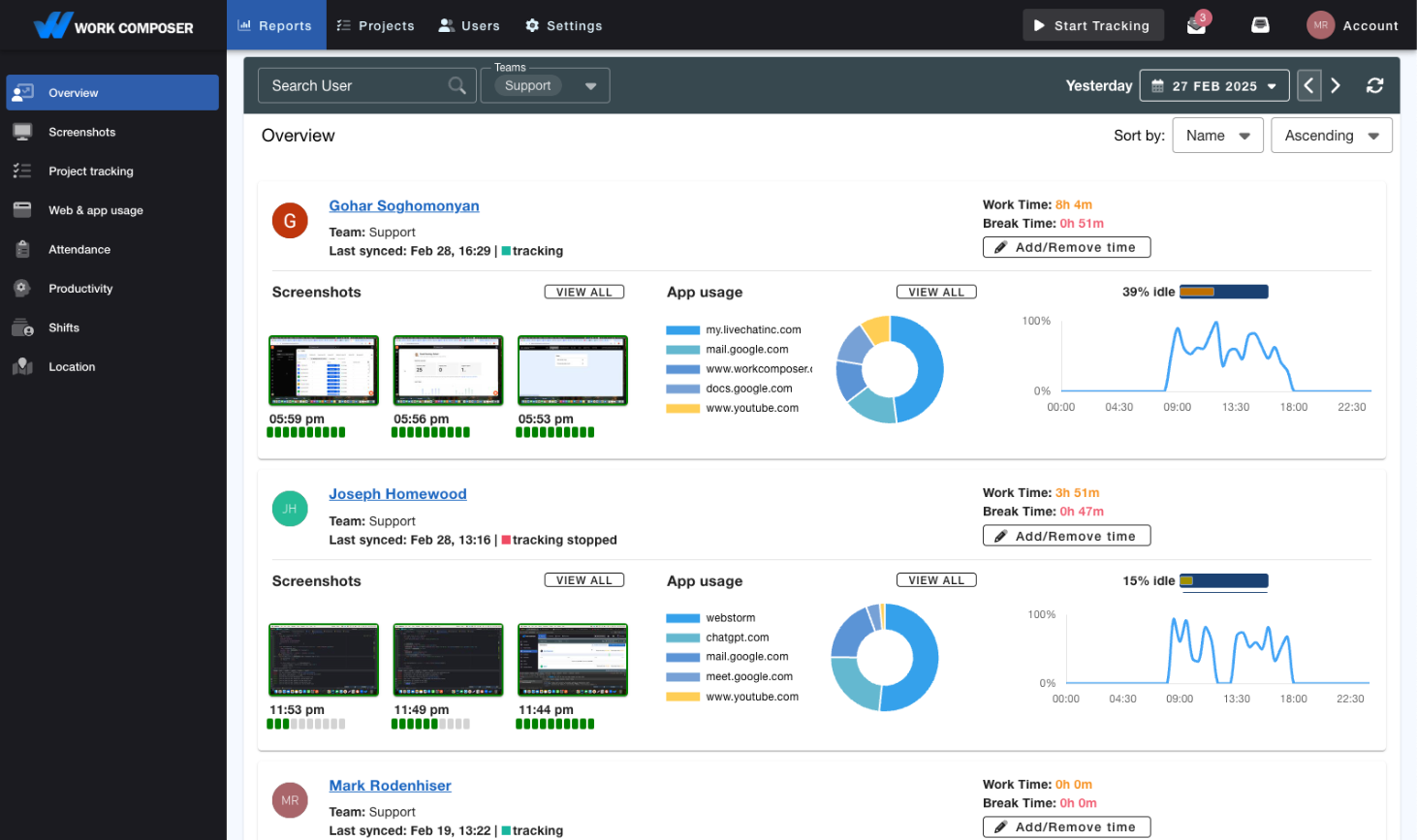
The company replaced invasive monitoring with WorkComposer's transparent, trust-based approach that respects employee autonomy while providing visibility into productivity patterns.
- 1. Employee-Controlled Privacy
- Screenshots and activity tracking became employee-controlled features. Team members could choose their own privacy settings, pause tracking during personal time, and delete any captured data they weren't comfortable sharing. This shifted the dynamic from surveillance to self-documentation.
- 2. Focus on Results, Not Activity
- Management stopped monitoring keyboard activity and mouse movements. Instead, WorkComposer provided aggregate productivity insights showing when teams were most focused, which projects consumed the most time, and where bottlenecks occurred—without revealing individual moment-to-moment activity.
- 3. Transparent Team Communication
- Daily and weekly summaries helped team members communicate their progress naturally. Instead of managers demanding updates, engineers voluntarily shared what they worked on using automatically generated summaries that respected their privacy while demonstrating value.
- 4. Identifying Real Productivity Blockers
- Aggregate data revealed that excessive meetings, fragmented schedules, and frequent context-switching were the real productivity killers—not employee laziness. The company implemented "no meeting Wednesdays" and protected focus time blocks based on these insights.
Implementation
Cultural Shift Over Four Weeks
CEO and leadership team held company-wide meetings explaining the shift from surveillance to trust. Acknowledged past mistakes, apologized for invasive monitoring, and committed to a new approach focused on autonomy and respect.
Launched WorkComposer as an opt-in pilot with 15 volunteers. Emphasized employee control over privacy settings and collected feedback on what felt helpful versus invasive. Refined configuration based on team input.
Deployed to all 65 employees with training emphasizing privacy controls and opt-out options. Management committed to using only aggregate insights, never individual surveillance. Removed all previous invasive monitoring tools.
The aim by this stage is a clear lift in employee satisfaction, with team members feeling trusted rather than watched — and high voluntary adoption as people find personal value in the insights.
Potential Results
The Kind of Impact a Trust-First Shift Could Have
The outcomes below are illustrative of what teams in this situation tend to aim for — not measured results from a specific customer.
- ↑Higher Real Productivity
- When engineers stop spending energy on "looking busy" and focus on deep work, velocity and code quality tend to improve — the opposite of what activity-surveillance usually produces.
- ↓Lower Turnover
- Removing a surveillance culture addresses a common, expensive driver of attrition — and lower turnover saves meaningful recruiting and training cost.
- ★Better Culture Signal
- Teams that feel trusted rather than watched tend to rate culture higher in internal surveys, and a healthy reputation can become a recruiting advantage.
- 🎯More Initiative
- Autonomy tends to encourage engineers to propose and implement improvements on their own, rather than delivering only what's explicitly required.
- 💰Cost Savings
- Lower turnover, retiring expensive invasive-monitoring tools, and fewer overtime hours from more efficient work can add up to real annual savings.
- ⚖Less Burnout
- Replacing constant-surveillance pressure with autonomy tends to reduce burnout, with people taking proper breaks and managing their own schedules.
Why engineering teams take this approach
Surveillance-style monitoring can cost you your best engineers. The appeal here is the opposite: aggregate, employee-controlled insight that respects autonomy — trusting talented people tends to produce better results than watching them.
This scenario is illustrative. WorkComposer supports a transparency-first setup with employee-controlled privacy settings. To see how it fits your team, start with a free trial.
Related Solutions
Explore How WorkComposer Can Help Your Business
Remote Teams
Build trust and transparency with distributed teams without invasive surveillance.
Software Development
Optimize sprint planning and velocity without micromanaging developers.
Employee Productivity
Increase productivity through insights and autonomy, not surveillance.
Ready to transform your team's productivity?
Join 200,000+ users tracking time smarter. Start your free trial today—no credit card required.
- Setup takes less than 5 minutes
- Full access to all features
- Cancel anytime, no questions asked
- Dedicated support to get you started