How a Software Team Could Improve Sprint Estimation and Velocity
An illustrative look at how an engineering team could use development-focused time data to calibrate sprint estimates, surface bottlenecks like slow code review, and ship more predictably.
Illustrative scenario. This is a composite example based on typical WorkComposer deployments — not a specific named customer. The company, figures, and quote are illustrative and show how the product is used, not guaranteed results.
Illustrative outcomes for a scenario like this
Scenario Profile
Picture a fast-growing B2B SaaS company building cloud-based enterprise software. Around 60 engineers are organized into several scrum teams running two-week sprints — frontend, backend, DevOps, and QA working on a complex microservices architecture.
- Engineering Team
- ~60 engineers
- Structure
- Multiple scrum teams
- Sprint Cycle
- 2 weeks
- Key Need
- Predictable sprints
The Challenge
Poor Sprint Estimation and Missed Delivery Deadlines
- Inaccurate Sprint Estimations
Engineering teams consistently underestimated story points and task complexity. Sprint commitments were based on gut feeling rather than historical data. The result: 40% of sprints failed to meet commitments, damaging team morale and stakeholder confidence.
- Missed Delivery Deadlines
Major product releases consistently slipped by 2-4 weeks. Sales had to delay customer launches, marketing campaigns missed windows, and the company lost competitive opportunities. Leadership had no visibility into why deadlines were missed or how to prevent it.
- Unclear Productivity Metrics
The VP of Engineering had no objective way to measure team productivity or identify bottlenecks. Were engineers spending too much time in meetings? Was code review slowing down delivery? Were certain types of work taking longer than expected? There was no data to answer these questions.
- Hidden Time Sinks
Engineers spent significant time on non-development activities—meetings, Slack conversations, context switching—but the organization had no visibility into how much productive coding time was actually available. This made capacity planning impossible and sprint commitments unrealistic.
The Solution
Development-Focused Time Tracking with Sprint Integration
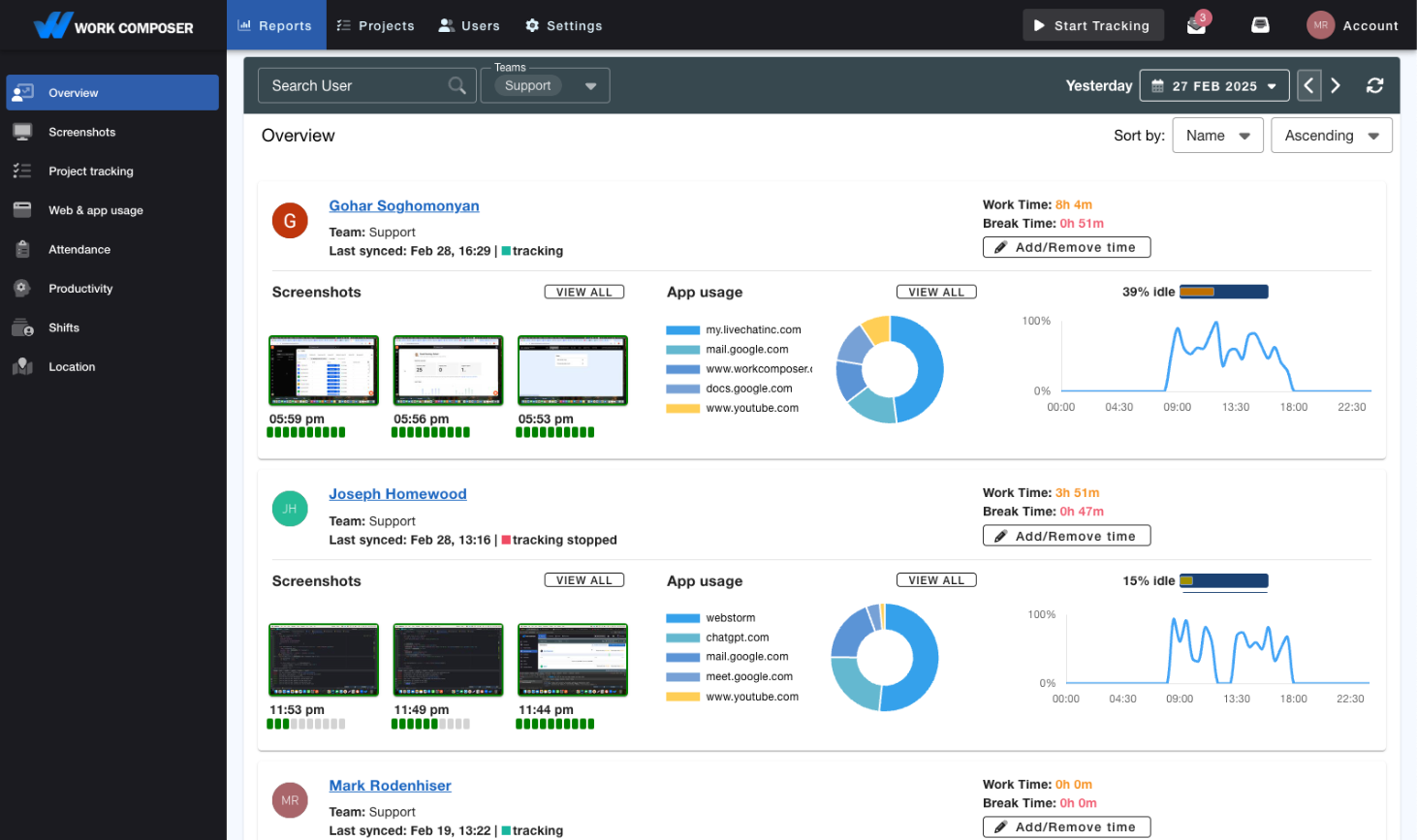
In this scenario, the team rolls out WorkComposer across engineering with a focus on improving sprint-planning accuracy, measuring actual development time, and finding productivity bottlenecks — without micromanaging individual engineers.
- 1. Sprint-Level Time Tracking
- Engineers tracked time against specific sprint tasks and user stories. Historical data showed how long different types of work actually took—API development, frontend features, bug fixes, code reviews—providing concrete data for future sprint planning instead of guesswork.
- 2. Development Activity Categorization
- Time is categorized into development activities: coding, code review, testing, debugging, meetings, documentation, and research. This kind of breakdown often reveals how little of an engineer's day is actually spent coding, with the rest consumed by meetings and context switching.
- 3. Velocity-Based Sprint Planning
- Engineering managers use historical time data to calibrate story points and sprint capacity. Seeing that nominally equal-point stories actually take very different amounts of time — by type and team — moves sprint planning from guesswork toward something grounded in real numbers.
- 4. Bottleneck Identification
- Time data frequently surfaces code review as a major bottleneck — PRs sitting for many hours before anyone looks at them. Armed with that, a team can institute review rotation and time-allocation targets to shrink review latency and speed up the whole development cycle.
Implementation
Gradual Rollout Over Three Sprints
Started with one 8-person scrum team for a full sprint. Engineers tracked time against sprint tasks. Collected feedback on workflow integration and refined categorization rules. Initial data already revealed surprising insights about code review bottlenecks.
Deployed to all 60 engineers across 8 scrum teams. Created templates for common development activities (coding, PR review, testing, debugging). Integrated with Jira for automatic task assignment. Trained engineering managers on using data for sprint planning.
Engineering managers use historical time data for sprint planning, recalibrating story points against actual time spent. The aim is more realistic commitments — and teams that start meeting them consistently rather than routinely overcommitting.
Potential Results
The Kind of Impact a Team Could See
The outcomes below are illustrative of what teams in this situation tend to aim for — not measured results from a specific customer.
- ↑Higher Sprint Velocity
- Better estimation and bottleneck removal can lift velocity — not by working longer hours, but by making the team more efficient and sprints more predictable.
- ↑Better Estimation Accuracy
- Calibrating commitments against historical actuals helps teams commit to realistic goals — which builds stakeholder confidence in engineering estimates and reduces cross-functional tension.
- ↑Faster Feature Delivery
- Identifying and removing bottlenecks — especially code-review delays — can meaningfully shorten feature cycle time without adding headcount.
- ↓Less Time in Meetings
- Seeing how much of the day meetings actually consume gives engineering leaders the evidence to introduce no-meeting blocks and trim recurring meetings, freeing time for focused work.
- ✓More Predictable Releases
- More realistic sprint commitments tend to translate into releases that ship closer to schedule — which lets sales and marketing plan launch dates with more confidence.
- ↑Higher Engineer Morale
- Realistic, data-backed commitments mean fewer crunch-time situations — predictable, achievable sprints tend to improve morale and support retention.
Why engineering teams take this approach
The appeal is trading gut-feel sprint planning for objective data — surfacing the bottlenecks (like slow code review) that quietly kill velocity, so estimates get accurate and engineers trust commitments because they're realistic.
This scenario is illustrative. To see what your team's actual time data reveals, the place to start is a free trial or our software development solutions page.
Related Solutions
Explore How WorkComposer Can Help Your Engineering Team
Software Development Time Tracking
Improve sprint velocity and optimize engineering productivity with development-focused time tracking.
Project-Based Work
Track project budgets and profitability in real-time with accurate time allocation.
Remote Team Time Tracking
Build trust and accountability across distributed engineering teams.
Ready to transform your team's productivity?
Join 200,000+ users tracking time smarter. Start your free trial today—no credit card required.
- Setup takes less than 5 minutes
- Full access to all features
- Cancel anytime, no questions asked
- Dedicated support to get you started