How a Creative Agency Could Recover Lost Billable Revenue
An illustrative look at how a mid-size creative agency could reduce billing disputes and improve billing realization with automatic time tracking and proof of work.
Illustrative scenario. This is a composite example based on typical WorkComposer deployments — not a specific named customer. The company, figures, and quote are illustrative and show how the product is used, not guaranteed results.
Illustrative outcomes for a scenario like this
Scenario Profile
Picture a full-service creative agency specializing in branding, web design, and digital marketing for mid-market clients. With around 40 employees — designers, developers, copywriters, and account managers — the agency juggles dozens of active client projects at any given time.
- Team Size
- ~40 people
- Work Type
- Client projects
- Billing Model
- Hourly & fixed
- Tracking Need
- Billable hours
The Challenge
Lost Billable Hours and Billing Disputes
- Revenue Leakage
The agency's creative team routinely forgot to log billable hours, especially for short client calls, email revisions, and internal meetings. Partners estimated that 20% of billable time was never captured—representing approximately $1M in lost annual revenue.
- Client Billing Disputes
Without proof of work, clients frequently questioned invoices. 30% of invoices faced disputes, particularly for design revisions and feedback cycles. This led to write-offs, delayed payments, and strained client relationships.
- Manual Time Tracking Failures
The agency used manual timesheet entries that required team members to remember and reconstruct their day. Designers and developers consistently underreported hours, especially on internal revisions that clients should have been billed for.
- Low Billing Realization
The agency's billing realization rate had dropped to 75%, meaning for every hour worked, only 0.75 hours were billed and collected. This made it impossible to achieve target profit margins and forced the agency to take on more clients than they could comfortably handle.
The Solution
Automatic Time Tracking with Proof of Work
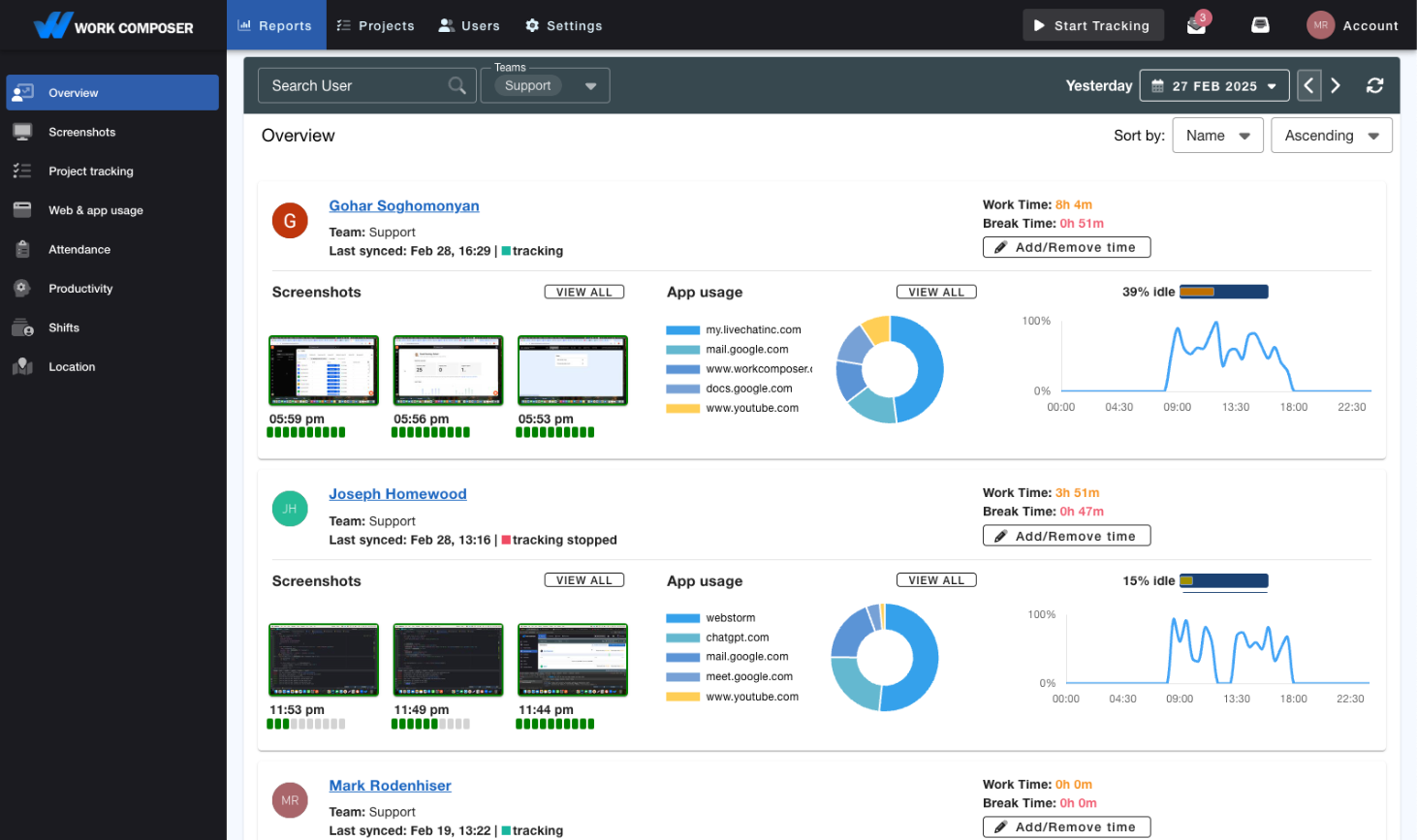
In this scenario, the agency rolls out WorkComposer across the whole team, with a focus on automatic billable-hour capture and verifiable proof of work for client billing.
- 1. Automatic Time Capture
- Designers, developers, and account managers no longer needed to remember to start timers. WorkComposer automatically tracked time spent on client work based on which files, applications, and projects they were working on.
- 2. Project-Level Time Allocation
- Time was automatically allocated to specific client projects and tasks. At the end of each day, team members could review and confirm their time allocation with just a few clicks, rather than reconstructing their entire day from memory.
- 3. Screenshot-Based Proof of Work
- Optional screenshots captured proof of actual design work, client communication, and development activity. When clients questioned invoices, the agency could show exactly what work was performed during billed hours.
- 4. Transparent Client Billing Reports
- The agency began attaching detailed time reports to invoices showing task breakdowns, time spent on each deliverable, and optional work samples. This transparency eliminated disputes and built client trust.
Implementation
Smooth Rollout in Two Weeks
Started with 5 team members across different roles (designer, developer, account manager). Collected feedback, refined workflows, and identified best practices for client project tracking.
Deployed to all 40 employees with live training sessions. Created project templates for common client engagement types. Set up billing report templates for invoice attachments.
Within the first month, the agency captured 18% more billable hours than the previous month. Client feedback on transparent billing was overwhelmingly positive.
Potential Results
The Kind of Impact an Agency Could See
The outcomes below are illustrative of what teams in this situation tend to aim for — not measured results from a specific customer.
- $Recover Billable Revenue
- Capturing billable hours that manual timesheets miss — short calls, email revisions, quick consults — can add up to meaningful recovered revenue over a year, with fewer write-offs from billing disputes.
- ↑Improve Billing Realization
- When more of the hours actually worked get billed and collected, billing realization rises — adding revenue without taking on new clients.
- ↓Reduce Billing Disputes
- Invoices backed by detailed time reports and optional work verification give clients confidence, which tends to mean fewer disputes and faster payment cycles.
- ↑Strengthen Client Relationships
- Transparent billing and clear proof of the value delivered can strengthen client trust and support retention over time.
- ⏱Fast Payback on Cost
- At $3.99/user/month (verified at workcomposer.com/pricing), even recovering a few billable hours can cover the software cost quickly.
- ★Less Timesheet Busywork
- Automatic tracking removes end-of-day timesheet reconstruction, cutting administrative burden and freeing up time for creative work.
Why agencies take this approach
The pull is simple: stop leaving billable time on the table, give clients invoices they trust, and free the team from timesheet busywork — without adding headcount.
This scenario is illustrative. If it matches how your agency works, the best way to see the numbers for your own team is to start a free trial.
Related Solutions
Explore How WorkComposer Can Help Your Business
Billable Hours Tracking
Capture every billable minute and maximize revenue with automatic time tracking.
Agency Time Tracking
Maximize profitability with project insights and transparent client billing.
Ready to transform your team's productivity?
Join 200,000+ users tracking time smarter. Start your free trial today—no credit card required.
- Setup takes less than 5 minutes
- Full access to all features
- Cancel anytime, no questions asked
- Dedicated support to get you started