How a Law Firm Could Capture More Billable Time and Reduce Billing Disputes
An illustrative look at how a law firm could capture billable minutes that manual entry tends to lose, improve billing realization, reduce client disputes, and keep audit-ready documentation.
Illustrative scenario. This is a composite example based on typical WorkComposer deployments — not a specific named customer. The company, figures, and quote are illustrative and show how the product is used, not guaranteed results.
Illustrative outcomes for a scenario like this
Scenario Profile
Picture a mid-size law firm specializing in corporate law, litigation, and intellectual property, with around 25 attorneys plus paralegals and administrative staff. It handles complex matters for mid-market and enterprise clients at billing rates in the hundreds of dollars per hour.
- Attorneys
- ~25
- Practice Areas
- Corporate, litigation, IP
- Billing
- Hourly, by matter
- Key Need
- Capture billable time
The Challenge
Billable Hour Leakage and Client Trust Issues
- Billable Hour Leakage
Attorneys consistently forgot to log billable time, especially for short client calls, email exchanges, and legal research. Partners estimated 15-20% of billable hours were lost due to poor time capture habits. With hourly rates averaging $450, this represented significant revenue leakage.
- Client Billing Disputes
Without proof of work, clients frequently questioned invoices. Corporate clients demanded detailed documentation of hours billed. Disputes led to write-offs averaging 8-12% of invoiced amounts, damaged client relationships, and delayed payment cycles by 30-45 days.
- Case Profitability Uncertainty
The firm had no real-time visibility into case profitability. Partners couldn't identify which cases were profitable or which practice areas generated the best margins. This made it impossible to make data-driven decisions about case acceptance, staffing, or pricing.
- Compliance Documentation Gaps
Manual timesheets lacked the detailed audit trail required for malpractice insurance, bar association audits, and client disputes. The firm couldn't prove work performed, creating liability exposure and compliance concerns during audits and legal challenges.
The Solution
Legal-Specific Time Tracking with Case Profitability
In this scenario, the firm configures WorkComposer for legal practice — automatic billable-hour capture, case-level profitability tracking, and comprehensive documentation tailored to its matters.
- 1. Automatic Billable Time Capture
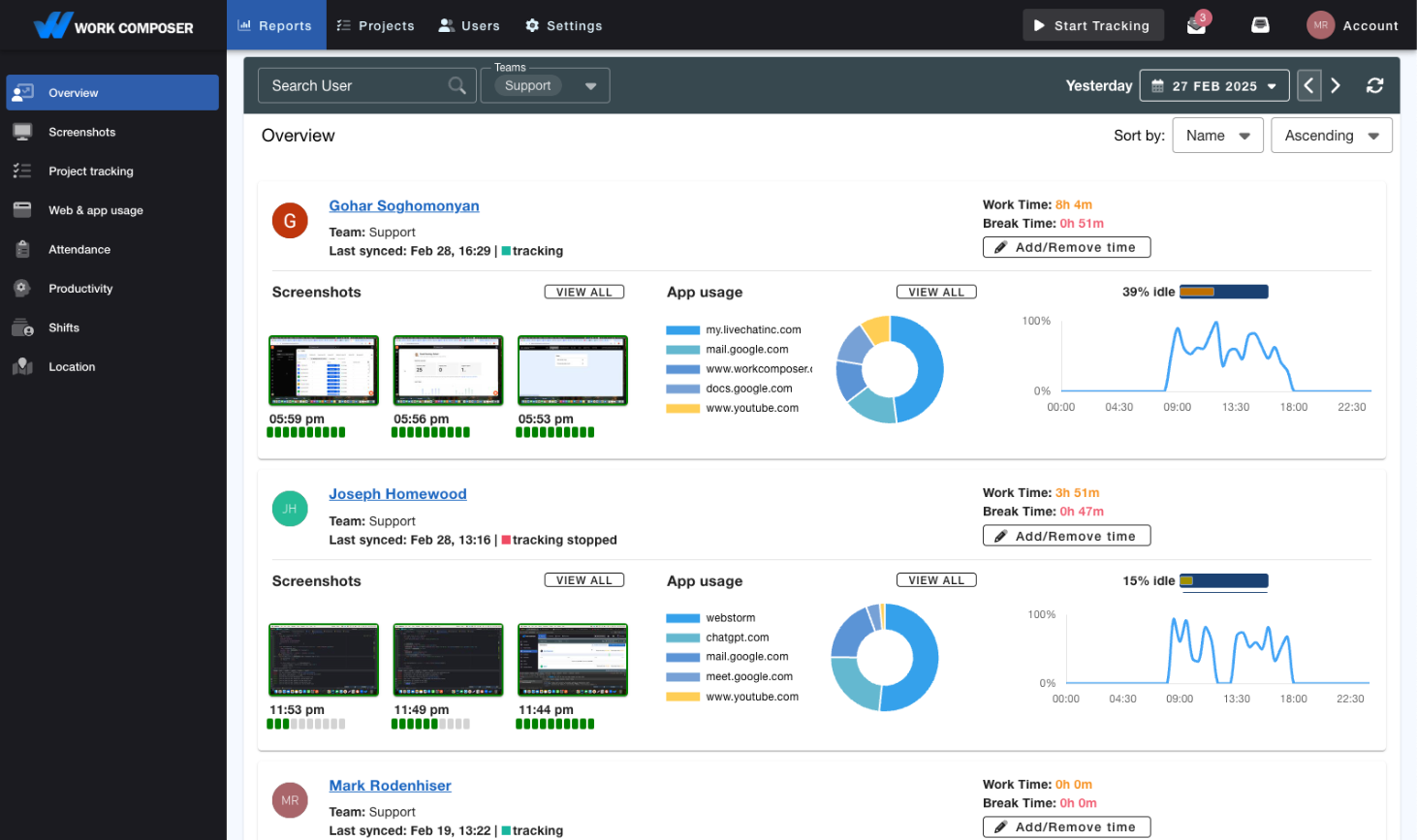
- Attorneys no longer needed to remember to start timers or manually log hours. WorkComposer automatically tracked time spent on case documents, legal research, client communication, and court preparation. Every billable minute was captured, including the short calls and emails that were previously lost.
- 2. Case-Level Time Allocation and Profitability
- Time was automatically allocated to specific cases and matters. Real-time dashboards showed case profitability, hours worked vs. budget, and attorney utilization. Partners could identify profitable cases, over-budget matters, and optimal staffing allocations instantly.
- 3. Proof of Work for Client Billing
- Optional screenshots and activity logs provided verifiable proof of work performed. When clients questioned invoices, the firm could demonstrate exactly what legal work was done—showing document drafting, research databases accessed, and client communication. This transparency eliminated disputes.
- 4. Compliance-Ready Documentation
- Comprehensive audit trails documented all billable work with timestamps, activity descriptions, and work verification. This satisfied bar association requirements, malpractice insurance audits, and client billing inquiries. The firm had bulletproof documentation for any challenge or audit.
Implementation
Phased Rollout by Practice Area
Met with managing partners to configure case tracking, matter codes, and billing categories. Set up ethical walls for confidential matters, configured hourly rates, and established approval workflows for timesheet review.
Deployed to corporate law practice group. Trained attorneys on case time allocation, billable vs. non-billable categorization, and proof of work features. Collected feedback on legal-specific workflows and billing integration needs.
Expanded to all 25 attorneys across litigation and IP practice groups. Configured integration with existing billing system for seamless invoice generation. Set up case profitability dashboards for partners and practice group leaders.
The first invoices run on automated time data. With more billable hours captured and detailed work summaries attached, the aim is fewer client questions and faster payment approval.
Potential Results
The Kind of Impact a Firm Could See
The outcomes below are illustrative of what firms in this situation tend to aim for — not measured results from a specific customer.
- ↑Higher Billable Realization
- Capturing previously lost billable hours and cutting write-offs from disputes lifts realization — at legal billing rates, even a modest improvement adds meaningful revenue without adding attorneys or matters.
- ↓Fewer Billing Disputes
- Detailed time records and optional work verification answer the questions corporate clients tend to raise — which reduces disputes and can shorten payment cycles.
- ↑More Hours Captured
- Automatic tracking recovers the short calls, emails, and research that manual entry loses — recovering even a few hours per attorney per week compounds over a year.
- ✓Audit-Ready Records
- Comprehensive audit trails support bar-association records requirements and malpractice-insurance reviews, with clear documentation of work performed against each matter.
- $Case Profitability Visibility
- Real-time case-level data helps partners spot unprofitable case types and over-serviced clients, so pricing and scope decisions rest on data rather than guesswork.
- ⏱Less Admin Time
- Removing manual timesheet entry and end-of-day reconstruction frees attorney time that can be redirected to billable client work.
Why law firms take this approach
At legal billing rates, the hours lost to manual entry add up fast. The appeal is capturing every billable minute, answering client questions with proof of work, and giving partners real-time visibility into case profitability.
This scenario is illustrative. To see how much billable time your firm is currently losing, the place to start is a free trial or our legal solutions page.
Related Solutions
Explore How WorkComposer Can Help Your Business
Legal Firm Time Tracking
Built specifically for law firms and legal professionals with case profitability tracking.
Billable Hours Tracking
Capture every billable minute and maximize revenue with automatic time tracking.
Ready to transform your team's productivity?
Join 200,000+ users tracking time smarter. Start your free trial today—no credit card required.
- Setup takes less than 5 minutes
- Full access to all features
- Cancel anytime, no questions asked
- Dedicated support to get you started